
What to Look for in a Dive Operator
Planning a dive trip can feel overwhelming. In many popular dive destinations, there are countless operators to choose from. Some islands even have what feels like a strip mall of dive shops, with 20 different operations all competing for your business.
So how do you know which one is worth booking?
There are a few things I look for when choosing a dive operator, starting with the most important one: safety.
Safety First
The safety standards of a dive operation should be one of your biggest considerations. A good operator should have clear procedures, well-maintained equipment and staff who take safety seriously.
Unfortunately, not every dive shop operates to the same standard, and it’s the customer who can suffer when corners are cut.
One of the easiest ways to get a feel for a dive centre is to look at its equipment.
Rental Gear
Dive operators are generally required to maintain their equipment according to relevant safety standards. This includes BCDs, regulators and tanks.
Take a quick look at the rental gear when you arrive. Does it look clean and well maintained? Are regulators and BCDs visibly in good condition? Does the equipment look like it is being looked after?
You can also check the tanks. Depending on the country and the type of tank, inspection and hydrostatic testing requirements vary, but you should be able to see evidence that the tanks are being tested and maintained appropriately.
Reviews can also be useful here. Try searching reviews for words like “rental,” “gear,” “equipment” or “tank.” You may find comments from previous divers about the condition of the equipment.

What about the compressor?
If you can see where the compressor is located, have a look at that too.
I once dove with an operation where the compressor was kept on the boat, directly in the sun, and was extremely rusty. It was one of only two operators in the area at the time, and the other was closed for maintenance, so there wasn’t really another option.
That is not a good sign.
A compressor needs to be properly maintained and protected from contamination. Poorly maintained equipment can potentially contribute to contaminated breathing air, which is obviously something you want to avoid.
You don’t need to be an expert in compressors to spot obvious neglect. If the equipment responsible for producing your breathing air looks like it has been forgotten about, I’d be asking some questions.
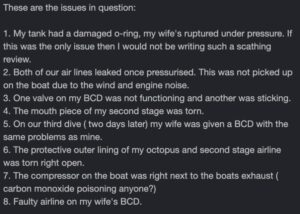
A list of bad equipment problems, including the compressor issue I ran into!
Read the Reviews
Reviews are one of the best ways to research a dive operator before you book.
I always start with the most recent reviews. This gives you a much better idea of what the operation is like now, including its current staff, equipment and procedures.
For example, if you find a terrible review from 10 years ago complaining about the rental gear, but dozens of recent reviews say the equipment is excellent, there’s a good chance the gear has since been replaced or upgraded.
I also like to search specifically for terms such as:
- Safety
- Unsafe
- Equipment
- Rental
- Gear
- Boat
- Crowded
One bad review isn’t necessarily a reason to avoid an operator. Reviews are written by real people, and you can’t please everyone.
But if you start seeing the same complaints repeatedly, particularly across Google, TripAdvisor and other review platforms, that’s worth paying attention to.
Look for patterns rather than individual complaints.
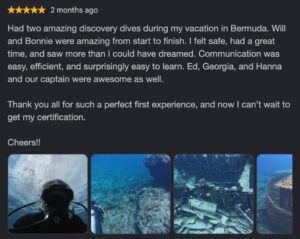
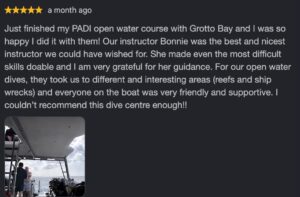
Both good reviews about the same awesome instructors!
How Big Are the Dive Groups?
Once I’m satisfied that an operator takes safety seriously, I start looking at the experience itself.
For me, group size matters a lot.
Diving is social, and some of the best days underwater are made better by the people you’re diving with. But being treated like a number in a group of 10, 12 or 15 divers isn’t everyone’s idea of a good dive.
I generally prefer operators that keep their groups small.
Check the Diver-to-Guide Ratio
Different dive centres have very different ideas about what constitutes a “small” group.
Some may take 10 or more divers with one guide, while others may limit groups to four or fewer.
If an operator offers small groups, they’ll often make a point of advertising it on their website. Reviews can also give you a good indication of what happens in practice.
Smaller groups generally mean a more personal experience. You’re more likely to stay together underwater, spend less time waiting for other divers and have more opportunity to stop and look at the interesting stuff.
And let’s be honest, if you’ve travelled halfway around the world to see a tiny seahorse, you don’t necessarily want to spend the entire dive trying to find it through 12 other divers.
Look at the Dive Centre’s Website
A dive operator’s website can tell you quite a lot.
Look at the information they provide about their staff, dive guides, group sizes, safety procedures and the way they operate.
You can often get a sense of the company’s values from how it presents itself online.
Are they focused on safety and conservation? Do they talk about small groups and personalised diving? Do they introduce their guides? Or is the website mostly a booking page with little information about the actual operation?
It isn’t a guarantee of quality, but it’s another useful piece of the puzzle.
Cross-Check Their Certification Agency
Before booking, it’s also worth checking that the dive centre is affiliated with the agency it claims to represent.
For example, if an operator says it is a PADI dive centre, you can check it through the official PADI Dive Shop Locator.
Most major training agencies have some form of centre or dive shop directory.
This is a quick way to verify that you’re dealing with a legitimate affiliated operation rather than a business simply using an agency’s name.
Agency affiliation isn’t the only measure of whether a dive shop is good, but it does provide another layer of reassurance that the operator is working within established training and operational standards.

Don’t Forget the Boats
The boat is another easy thing to assess, often before you’ve even left the dock.
Have a look at the overall condition of the boat. Is there enough space for everyone? Is there somewhere sensible to store your gear? Are the tanks secured properly? Are the ladders in good working order?
A boat doesn’t need to be brand new or luxurious to be a good dive boat. But it should be appropriately maintained, organised and suitable for the number of divers it carries.
Crowding is particularly worth considering. An overcrowded boat can make everything from gearing up to entering and exiting the water more difficult.
Sometimes you can learn a lot simply by looking at the boat before you step aboard.
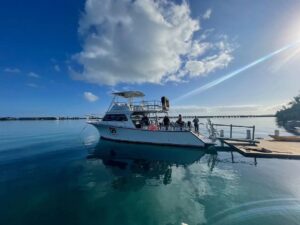
This boat is great!
Meet the Staff
The people running the operation can make or break a dive trip.
Good dive guides and staff should be clear, helpful and approachable. You want people who communicate well, answer your questions and make you feel comfortable asking for help.
This is another area where reviews can be useful, but there’s an important catch.
The dive industry has a huge staff turnover rate in many destinations.
The guide mentioned in a five-star review from last year may not even work there anymore.
That’s one reason I generally prefer to book one day of diving first, rather than committing to an entire week with an operator I’ve never used.
After a day, you’ll know whether you like the staff, the boats, the equipment, the group sizes and the general way the operation runs.
If you love it, book more.
If you don’t, you haven’t committed your entire trip to an operator you don’t enjoy diving with.
This can be particularly useful in destinations with lots of dive shops. Places such as Roatán, for example, have plenty of operators, so if one isn’t the right fit, there are usually other options nearby.
Finally, Ask Your Diving Friends
Sometimes the best recommendation doesn’t come from Google.
Ask other divers.
People love recommending dive operators they’ve had a great experience with, and a recommendation from someone whose diving style is similar to yours can be incredibly useful.
If your friend loves an operator because the guides are knowledgeable, the groups are small and they spend an hour looking for nudibranchs, there’s a good chance you’ll love it too, especially if that’s how you like to dive.
Of course, everyone’s priorities are different. Some divers want luxury boats and private guides. Others care more about price, flexibility or technical expertise.
The key is finding an operator that matches the way you like to dive.
The Bottom Line
Choosing a dive operator doesn’t have to be complicated.
Before booking, look at:
Safety → Equipment → Reviews → Group sizes → Agency affiliation → Boats → Staff
No single factor can tell you whether a dive operator is excellent. But when you put all of these things together, you can usually get a pretty good idea of what you’re signing up for.
And remember: you don’t have to stay with an operator just because you’ve booked with them once.
If the equipment makes you uncomfortable, the boat is overcrowded, the staff aren’t a good fit or something simply doesn’t feel right, trust your instincts.
There are plenty of great dive operators around the world.
The trick is finding the one that’s right for you.