How to Use a Compass Underwater: A Simple Guide for Divers
Compass work can seem daunting. Plenty of new divers shy away from guiding dives or using a compass because it feels confusing. Yet, time and time again, divers can find themselves turned around underwater and unable to locate their exit point.
The good news? Compass work doesn’t need to be scary. In fact, it’s easier than you might imagine.
Most basic compass navigation comes down to three simple skills:
- Swimming a straight line
- Turning a reciprocal
- Swimming a square
Master these fundamentals and you’ll have a solid foundation for more advanced compass navigation.
The Parts of an Underwater Compass
Before getting in the water, it’s worth familiarising yourself with the main parts of your compass.
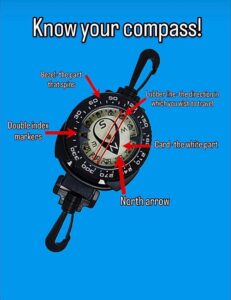
Lubber Line
The lubber line runs through the compass and indicates your direction of travel. It should always be aligned with where you want to go and with the centre of your body.
Think of it as the arrow telling you, “This is where I’m going.”
Bezel
The bezel is the rotating part of the compass. It contains the double index markers, which allow you to set and maintain a heading.
Double Index Markers
The double index markers are used to set your heading. To establish a heading, you line these markers up with the North arrow on the compass card.
Card
The card sits inside the compass and contains the directional markings. For the compass to work correctly, the card needs to remain flat.
How to Position Your Compass Underwater
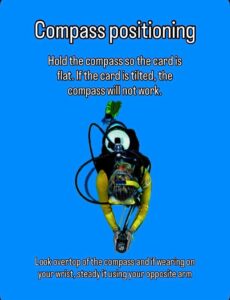
Successful compass navigation starts with good body position.
Both you and your compass need to remain flat while swimming.
First, establish a comfortable hover and maintain good trim. Then position your compass so it is flat in front of you.
If your compass is loose or attached to a console, hold it with both hands out in front of you.
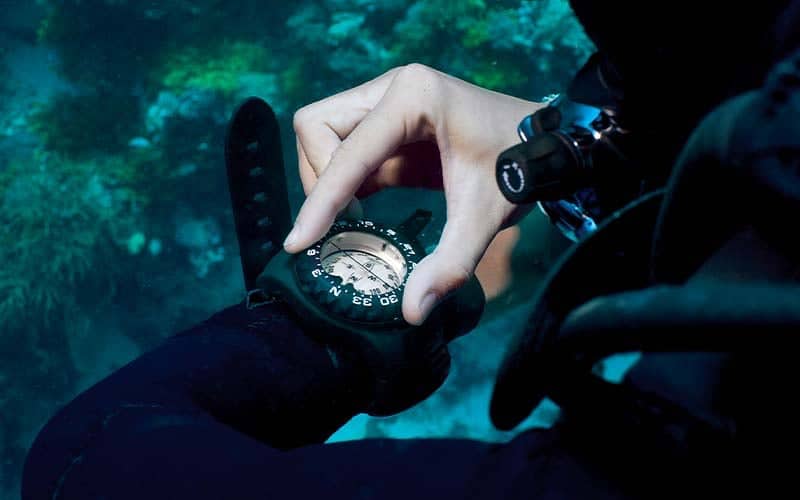
If your compass is mounted on your wrist, use your other arm to point in the direction you want to travel. Bend the arm holding the compass to approximately 90 degrees and place that hand against your opposite elbow.
This position helps keep your body aligned with your direction of travel while also keeping the compass level.
Remember: when swimming on a compass heading, make sure you are propelling yourself forward rather than gradually swimming upward.
How to Swim a Straight Line
Swimming a straight line is one of the most important compass skills to master.
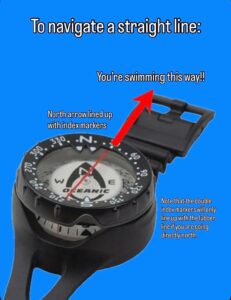
- Point the lubber line in your direction of travel and keep it aligned with your body.
- Rotate the bezel until the double index markers line up with the North arrow on the compass card.
- Swim while keeping the two North arrows together.
A useful way to remember this is “the boat stays in the harbour.” The North arrow on the card is your boat, and the double index markers are the harbour. As long as the boat stays in the harbour, you are maintaining your heading.
What If the North Arrow Moves?
If your North arrow becomes misaligned with the double index markers, do not rotate the bezel.
Instead, stop and slowly move your body while keeping the lubber line aligned with your body. Continue moving until the North arrows line up again.
Once they are aligned, you are back on your original heading and can continue swimming.
This is a really important distinction: the bezel sets your heading; your body maintains it.
How to Turn a Reciprocal
A reciprocal simply means turning 180 degrees. In other words, turning around and heading back the way you came.
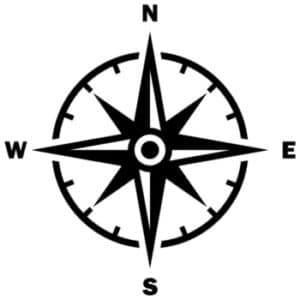
A compass is divided into four primary directions:
- North
- East
- South
- West
Each is 90 degrees apart, meaning North and South are exactly 180 degrees apart.
To turn a reciprocal, simply turn your body while looking at the compass until South is positioned between the double index markers.
Once South is aligned, you have two options:
- Keep South between the double index markers and swim back to your original starting point.
- Rotate the bezel so that North is between the double index markers, then swim back while keeping North aligned.
Personally, I prefer the first option. It removes an extra step and gives you one less opportunity to introduce human error.
The simpler your navigation is underwater, the better.
How to Swim a Square
Swimming a square sounds more complicated than it really is.
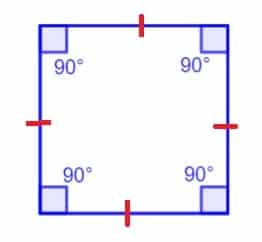
A square has four corners, and each corner is 90 degrees. Conveniently, the main compass directions are also separated by 90 degrees.
That means you don’t need to do any underwater maths.
To swim a square:
- Point the lubber line in your direction of travel and align it with your body.
- Rotate the bezel until the double index markers line up with the North arrow on the card.
- Swim while keeping the North arrows together- the “boat in the harbour.”
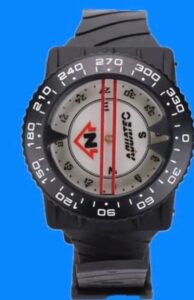
- When you’re ready to make your first turn, stop and rotate your body 90 degrees.
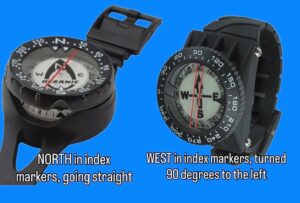
- Depending on which way you turned, either East or West will now be between the double index markers.
- Keep East or West aligned with the markers and swim the second leg.
- Turn another 90 degrees. South should now be between the double index markers.
- Swim the third leg.
- Make one final 90-degree turn and align East or West with the double index markers.
- Swim the final leg and you should arrive back at your starting point.
The key is to turn your body rather than spinning the bezel when making the 90-degree turns.
Swimming More Complicated Shapes
Unfortunately, not every compass navigation exercise is as straightforward as a square.
Shapes such as triangles involve different angles. For example, an equilateral triangle has three 60-degree corners.
In this situation, you’ll need to use your heading rather than simply relying on the four cardinal directions.
Start by setting your initial heading and swimming a straight line. When you’re ready to turn, add or subtract the required angle from your original heading. Turn your body until you reach that new heading, then rotate the bezel to bring North back into alignment with the double index markers.
For example, if your original heading is 090° and you need to turn 60°, your new heading would be 150°.
Do the Maths Before You Get Wet
There’s no reason to make navigation harder than it needs to be.
If you know you’ll be navigating a shape with several different headings, work them out before the dive. Write the headings down on a slate so you can refer to them underwater.
That way, you can eliminate unnecessary mental arithmetic when you’re already dealing with depth, buoyancy, gas, your team and everything else happening around you.
Keep It Simple
Compass navigation doesn’t have to be intimidating.
Start with the basics: learn how to maintain a straight heading, turn a reciprocal and navigate a square. Once those skills become second nature, more complicated navigation becomes much easier to understand.
The most important thing is to practise. Build your confidence in a controlled environment, focus on maintaining good trim and buoyancy, and remember that your compass is there to make navigation easier, not more complicated.
Master the fundamentals, and you’ll soon find that guiding a dive with a compass feels far less daunting than it did at first.