Scuba Diving a Sunken Roman City in Italy
Italy is famous for countless reasons: pizza, gelato, ancient ruins, the Amalfi Coast, and, of course, Rome. But what many people don’t realise is that some of the country’s most fascinating Roman history lies beneath the sea.
Just two hours south of Rome is Naples, the birthplace of pizza and one of Italy’s most historically rich cities. While its streets are packed with history, some of its greatest treasures are hidden below the surface. Off the coast lies Baia, an ancient Roman spa town that slowly disappeared beneath the sea. Today, it is one of the world’s only underwater archaeological parks, where divers can swim through 2,000-year-old villas, mosaics, and streets.
Here’s the story of how an entire Roman city ended up underwater, and what it’s like to dive it today. Lets scuba dive a sunken roman city in Italy!
What Was Baia?
Baia was a luxurious Roman resort town that flourished between the 3rd century BC and the 5th century AD. Often described as the “Las Vegas of Ancient Rome,” it was where wealthy Romans escaped the crowds of Rome to relax in lavish villas overlooking the Bay of Naples.
The area’s natural geothermal activity made it the perfect destination for thermal baths and spas, attracting emperors, senators, and the Roman elite.
The town was divided into three main areas:
- Portus Julius (the harbour)
- The residential villas
- A bridge connecting the harbour and the villas
Although Baia wasn’t a particularly large city, it was built with incredible detail. Marble columns decorated grand courtyards, colourful mosaics covered the floors, and luxurious spa houses overlooked the sea.
For centuries it thrived, until nature slowly reclaimed it.
Bradyseism: The Force That Sank the City
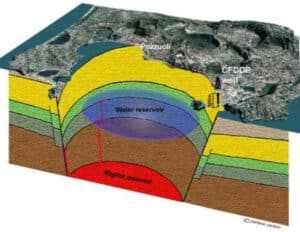
The reason Baia now lies underwater is a geological process called bradyseism.
The word comes from Greek, with bradys meaning “slow” and seismos meaning “movement.” It describes the gradual rising and sinking of the Earth’s crust, driven by changes in underground magma chambers.
Bradyseism occurs in two phases:
- Uplift, when magma and volcanic gases build underground, pushing the land upwards.
- Subsidence, when the pressure decreases and the ground slowly sinks.
Naples, Pozzuoli, Bagnoli and Baia all sit within the Campi Flegrei volcanic region; a massive super volcano made up of 24 craters and a large network of underground magma chambers.
Because of this, the ground here is constantly moving.
Over several centuries, Baia gradually subsided until the entire city slipped beneath sea level. Today the ruins sit just 3–5 metres underwater, making it accessible to both divers and snorkellers.
The area is now protected as the Underwater Archaeological Park of Baia.
Diving the Lost City of Baia
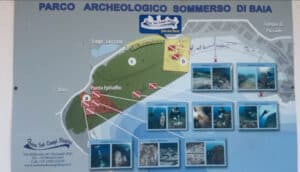
Boats to the underwater archaeological park depart from Pozzuoli, just outside Naples. Since the ruins lie only a short distance offshore, the boat ride from the dive centre takes just three to five minutes.
We dived with Centro Sub Campi Flegrei, who were fantastic from start to finish. The staff were knowledgeable, accommodating, and clearly passionate about protecting the archaeological site.
If you’re driving, allow an extra 30 minutes to find parking. Most nearby parking meters only accept coins or local payment methods, so it’s worth coming prepared.
There are several dive sites within the park, including:
- Villa a Protiro
- Ninfeo di Claudio
- The remains of Portus Julius
- Sections of the Roman bridge
- Geothermal dive sites
We completed two dives: Villa a Protiro and Secca delle Fumos, a geothermal site within Portus Julius.
Villa a Protiro
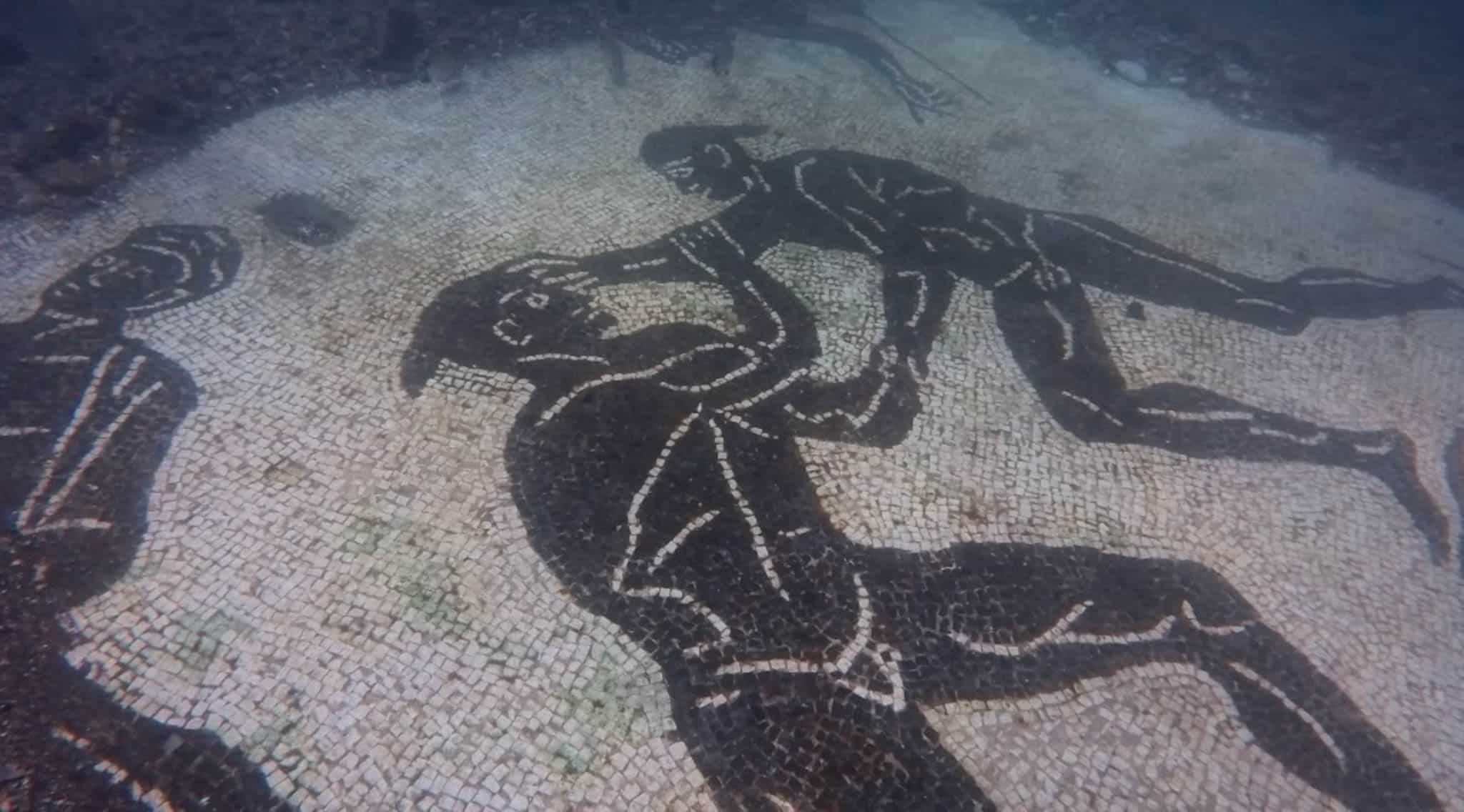
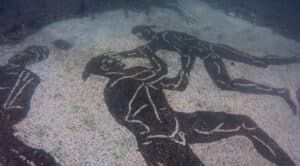
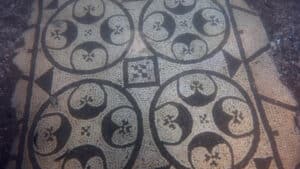
Villa a Protiro is best known for its beautifully preserved Roman mosaics.
Across the site we saw four different mosaic floors, each made from black and white stone arranged into intricate geometric designs. Considering they’re nearly 2,000 years old; they’re remarkably well preserved.
To help protect them, dive guides carefully cover the mosaics with sand at the end of each day. This shields them from fish and natural erosion, helping preserve them for future visitors.
Before the dive, I wasn’t sure there would be enough to explore for a full hour. I couldn’t have been more wrong.
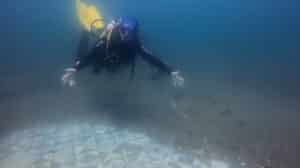
We swam through ancient swimming pools, saunas, steam rooms, courtyards and doorways, imagining what life must have been like when the Roman elite holidayed here.
One of the highlights was seeing a swimming pool that has only recently been uncovered. As the seabed slowly changes with ongoing bradyseism, more of the city continues to emerge from beneath layers of sediment.
What amazed me most was just how intact everything felt. Original floor tiles, mosaic patterns and room layouts remain visible, making it surprisingly easy to picture the city as it once was.
Unfortunately, we didn’t have time to dive Ninfeo di Claudio, another famous site within the park, where Roman statues still rest underwater.
Secca Delle Fumose
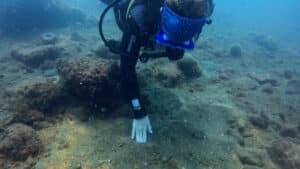
Secca delle Fumose, meaning “Smoky Reef,” showcases the geothermal forces that caused Baia to sink in the first place.
The reef is filled with hydrothermal vents that continuously release sulphur-rich gases and carbon dioxide from cracks in the seabed.
Scattered across the reef are bright yellow patches of sand stained by sulphur deposits. If you place your hand near the vents, you can feel warm water pouring from the seabed.
Some vents reach temperatures of up to 80°C, although the hot water mixes quickly with the surrounding seawater.
The amount of gas released varies over time. During periods of increased bradyseismic activity, pressure builds within the underground magma chambers, increasing both the number and intensity of the vents.
The site isn’t just fascinating geologically; it also attracts plenty of marine life. We spotted octopus, stonefish, large groupers and schools of barracuda taking advantage of the nutrient-rich environment.
It was the perfect dive to connect the area’s geological history with the archaeological story we’d explored earlier.
What’s Happening Now?
Ironically, while Baia originally disappeared because the ground sank, today the opposite is happening.
Since around 2005, much of the Campi Flegrei region has been undergoing another period of uplift. In some places, the ground is rising by between 10 and 25 millimetres each month.
This gradual uplift is slowly bringing parts of the ancient city closer to the surface. It’s one of the reasons archaeologists continue to discover previously buried structures, including the recently uncovered swimming pool at Villa a Protiro.
However, the region is also closely monitored because of increasing volcanic unrest.
Scientists continue to study Campi Flegrei carefully, as ongoing uplift may indicate changes occurring deep beneath the volcano. While no one can predict exactly what will happen, researchers are monitoring the area for signs that could lead to stronger earthquakes, increased volcanic activity, or future ground deformation. Scientists have predicted one of these events could occur as early as 2030.
For now, Baia remains one of the most unique dive sites in the world. A place where Roman history, geology and marine life come together in an unforgettable experience.
If you ever find yourself in Naples, don’t just visit Pompeii, go beneath the surface and dive an entire Roman city!